What Are the Top Bevel Cut Rails for Global Buyers?
Global buyers need more than attractive profiles when selecting Bevel Cut Rails. They need predictable performance across different climates, loading conditions, and installation practices. A rail that performs well in a dry warehouse may behave differently near a humid coast. Small details matter. Bevel accuracy, edge consistency, material grade, surface treatment, and fastening compatibility can influence safety and service life.
Rail fabrication consultant Adrian Cole explains, “A reliable bevel is not merely a sharp angle; it is a controlled transition that supports the whole installation.” His observation reflects a practical reality. Uneven cuts can create visible gaps, difficult joints, and premature wear. Experienced purchasing teams therefore request dimensional drawings, tolerance data, coating specifications, and sample approvals before placing large orders. They also examine packaging. Bent corners and exposed edges can damage otherwise well-made rails during long-distance transport.
The strongest options usually balance geometry, strength, finish quality, and supply reliability. Stainless steel may suit demanding coastal environments, while coated carbon steel can offer value for protected interiors. Aluminum remains useful when lower weight simplifies handling. No ranking is universal. That assumption can fail. Some buyers focus too heavily on unit price and overlook installation labor, replacement access, or local fabrication capacity. A more dependable comparison studies the complete ownership picture. This guide evaluates leading Bevel Cut Rails through those practical criteria, while acknowledging that regional requirements and project conditions can change the final choice.
What Is a Bevel Cut Rail and How Does It Work?
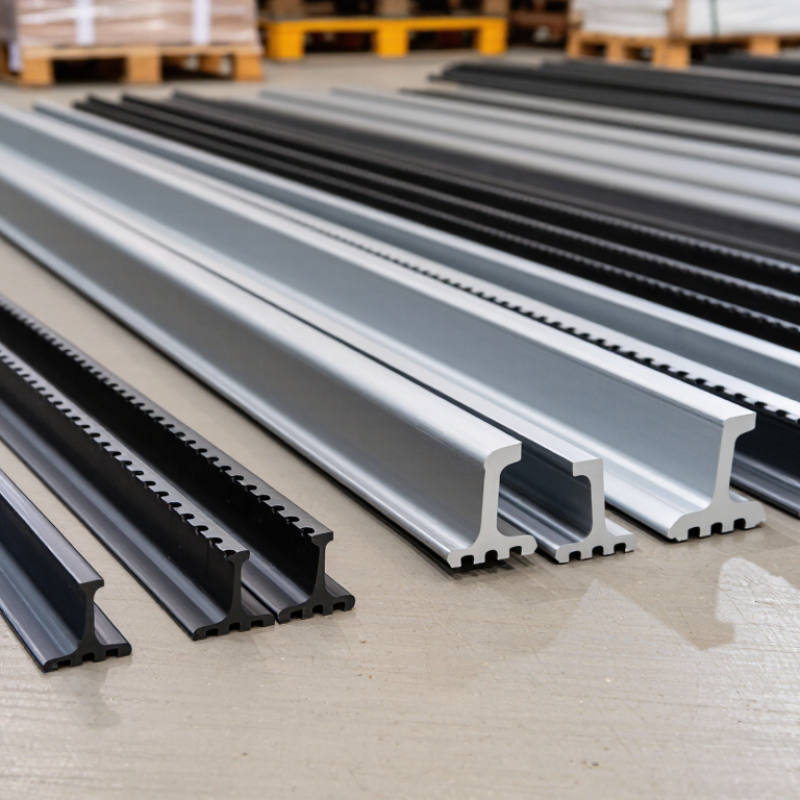
A bevel cut rail has an angled edge or end, rather than a straight 90-degree cut. In many guide, conveyor, and sliding systems, this design creates a gradual transition between rail sections. The wheel or carriage meets less of a sudden edge. That can reduce impact, vibration, and uneven movement.
The rail works through accurate contact between its running surface and the moving assembly. During installation, technicians align the bevelled ends, check the joint gap, and secure the rail to a rigid support. Even a small height difference can cause noise or premature wear. Buyers should examine steel grade, hardness, surface treatment, load capacity, dimensional tolerance, and corrosion resistance. Export documents and testing records also matter.
Real projects often reveal details that product sheets miss. Dust can collect near the joint. Temperature changes may alter the gap. A thicker rail is not automatically better if the support structure is weak. The best bevel cut rail matches the wheel profile, operating speed, and expected load. Ask for measured drawings and inspection data before ordering. One point deserves caution: “smooth operation” is not a complete performance claim. It should be linked to a defined load, speed, installation method, and service environment.
How Do Global Buyers Compare Bevel Cut Rail Performance?
What Are the Top Bevel Cut Rails for Global Buyers?
Global buyers should compare bevel cut rail performance through measurable evidence, not catalogue claims. The International Transport Forum’s Transport Outlook 2023 projects global passenger travel demand may rise 79% by 2050. Higher traffic increases the importance of clean cuts, stable weld preparation, and consistent rail geometry.
Check the bevel angle, cut-face flatness, burr height, and heat-affected zone. EN 13674-1 provides useful rail profile and dimensional references, while the AREMA Manual for Railway Engineering supports practical inspection methods. A reliable cut should leave a controlled edge without visible tearing. It should also preserve the rail’s hardness near the cutting line. Measure twice.
UIC Railway Statistics 2024 shows continued expansion in rail activity across several international markets. That trend makes repeatability more valuable than a single impressive test result. Buyers should request tolerance records, cutting-cycle data, and samples from different rail grades. Compare performance after repeated cuts, not only after the first attempt. Field teams often find that dust, vibration, and operator skill change the outcome.
A small admission: laboratory results can look better than site results. Not always. Temperature, worn tooling, and uneven clamping may reduce accuracy. Buyers should therefore review maintenance intervals, operator training, and independent inspection records. The strongest option is not necessarily the fastest cutter. It is the one producing consistent bevels, limited rework, and predictable weld preparation across different projects.
What Standards and Specifications Should Buyers Verify?
For global buyers, a bevel-cut rail is only as reliable as its verified specification.
EN 13674-1 should define the rail profile, steel grade, chemical limits, mechanical strength, and hardness. ASTM A759 may apply to carbon steel rails, depending on the project. Confirm which standard governs the purchase.
The bevel deserves separate control.
State the cut angle, angle tolerance, end squareness, finished length, burr height, and edge radius on the drawing. Check straightness across the full rail, not only near the cut. A small burr can obstruct fastening or create a stress point. It happens. Specify surface inspection and ultrasonic testing when safety and fatigue performance matter. Request an EN 10204 3.1 inspection certificate, heat number, test results, and traceability records for every bundle.
Market scale makes verification more important.
World Steel Association’s World Steel in Figures 2024 recorded about 1.89 billion tonnes of crude steel production in 2023. UNIFE’s World Rail Market Study 2024–2029 places annual rail-market volume near €200 billion. Large supply does not guarantee consistent cutting quality. Buyers should compare measured samples against approved drawings, not catalogue descriptions. I would also require a first-article inspection before bulk production. It costs time, but prevents expensive rework. One weakness remains: buyers often specify the rail grade clearly, yet leave the bevel geometry vague. That gap deserves correction.
How Can Buyers Choose Reliable Bevel Cut Rail Suppliers?
What Are the Top Bevel Cut Rails for Global Buyers?
Reliable bevel cut rails begin with controlled steel quality and accurate machining. The World Steel Association reported global crude steel production of about 1.89 billion tonnes in 2023. This scale creates many sourcing options, but quality can vary sharply between mills and processors. Buyers should request the rail grade, chemical composition, tensile strength, hardness, and heat-treatment records. The bevel angle also needs measurement data, not only a supplier’s written promise.
Inspect the production process closely. A dependable supplier should provide profile tolerances, cut-length records, surface inspection results, and batch traceability. Ask for recent inspection samples from the same production line. Check the bevel edge for burrs, cracks, uneven grinding, and heat discoloration. Small defects can complicate welding or installation later. I would not trust a polished certificate alone. Independent inspection remains worthwhile for large orders.
Logistics deserve equal attention. UNCTAD’s Review of Maritime Transport 2023 states that over 80% of global merchandise trade by volume moves by sea. Therefore, suppliers should explain export packaging, moisture protection, loading methods, and replacement procedures. Confirm whether documents match the actual shipment, including packing lists and material certificates. Response speed is useful evidence, but it is not proof of technical capability. A trial order can reveal more than a long presentation. Some buyers may still overlook packaging damage during evaluation, which is an avoidable mistake.