Choosing the right Anti-Settlement Track System requires more than comparing prices or advertised load ratings. Global buyers must examine ground conditions, drainage, traffic frequency, installation quality, and long-term maintenance needs. A reliable system should resist uneven movement while keeping doors, gates, vehicles, or guided equipment properly aligned. Small errors can become expensive failures.
This guide reviews seven leading systems for different operating environments and purchasing priorities. Each option is considered through practical criteria, including structural design, material quality, adjustment range, corrosion resistance, installation support, and replacement access. Field experience matters. A track that performs well on compact soil may struggle on reclaimed land or heavily trafficked sites. That difference is easy to miss.
Look closely.
The comparison also considers supplier transparency and technical documentation. Clear drawings, verified testing, warranty terms, and responsive engineering support can reduce purchasing risk across borders. Buyers should confirm local installation requirements before choosing a model. Product claims are not always equal to proven performance. That is an important limitation.
Some systems may offer stronger settlement control but require more careful foundations. Others may install faster but need closer inspection over time. No single solution fits every project. Conditions change. This review aims to provide a balanced starting point for engineers, contractors, facility managers, and international distributors. It combines technical reasoning with practical selection advice, while recognizing that site surveys and professional engineering checks remain essential before final approval.
Anti-settlement track systems are hardware assemblies designed to keep sliding panels aligned as loads, vibration, and building movement affect the installation. They commonly use reinforced tracks, adjustable rollers, guide channels, and stabilizing brackets. Together, these parts distribute panel weight instead of forcing one roller to carry excessive pressure.
The operating principle is simple. Rollers support the panel, while guides control its sideways movement. Height adjustment helps installers correct small differences in the floor or frame. Some systems also include anti-jump features, which reduce the risk of a panel lifting from the track during normal use. Correct fastening matters greatly. A strong track can still perform poorly when the substrate is weak or uneven.
For global buyers, technical documents should state the maximum panel weight, recommended panel thickness, adjustment range, corrosion resistance, and testing method. Buyers should also check whether replacement rollers and installation tools are available. In coastal or humid areas, protected metal surfaces may provide better long-term reliability.
No system is magic. Poor measurements, overloaded panels, and neglected cleaning can cause noise or gradual misalignment. A practical inspection should check smooth movement, fastener tightness, roller wear, and guide clearance. These checks are small, but they reveal problems early. One detail is often overlooked: the track must match the actual building condition, not only the catalog drawing.
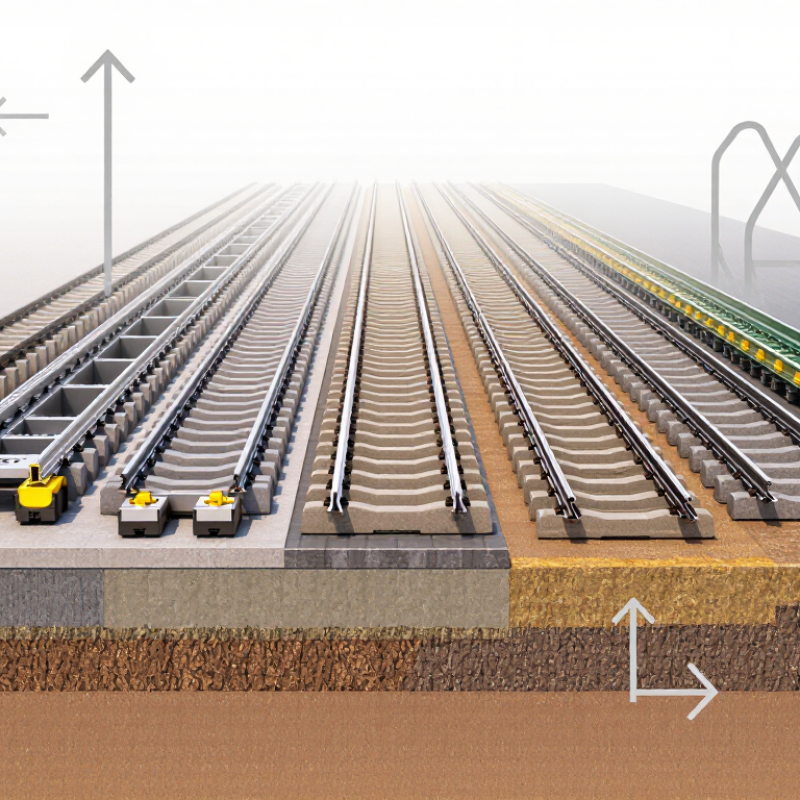
Anti-settlement track systems are designed to control ground movement before it creates misalignment, vibration, or unsafe wheel contact. The strongest systems combine deep foundations, adjustable supports, and drainage control. Piles or reinforced concrete bases transfer loads into stronger soil layers. Adjustable rail seats then correct small height changes without dismantling long track sections. Drainage matters more than many buyers expect. Water trapped below the track can soften soil and cause uneven settlement within one rainy season.
A dependable system should include continuous surveying points, movement sensors, and clear maintenance access. Laser alignment checks can identify horizontal drift near curves, switches, and loading zones. Settlement plates reveal vertical movement over time. These details help engineers separate temporary compaction from serious foundation failure. Strong lateral bracing also limits track spreading under repeated heavy loads. It should resist vibration, not merely static pressure. Small tolerances matter here. A few millimeters can increase wheel impact and accelerate component wear.
Global buyers should request soil reports, load calculations, corrosion protection details, and installation records. Regional climate conditions must shape the design. Frozen ground, coastal moisture, and expansive clay require different responses. No system is perfect. Poor drainage can defeat an expensive foundation. Installation quality can also undermine excellent engineering. A realistic specification should define inspection intervals, allowable movement, replacement procedures, and emergency adjustment methods. Independent testing adds credibility, although testing alone cannot replace regular field observation.
Global buyers need anti-settlement track systems that match soil conditions, traffic levels, and installation skills. Seven leading types deserve close comparison: adjustable roller tracks, reinforced concrete tracks, steel channel tracks, floating tracks, twin-guide tracks, modular replacement tracks, and drainage-integrated tracks.
Adjustable roller tracks help correct minor ground movement without removing the full assembly. Reinforced concrete tracks suit heavy gates and frequent industrial traffic. Steel channel tracks offer strong alignment, but they need corrosion protection and accurate anchoring. Floating tracks distribute movement across several support points. Twin-guide tracks reduce lateral stress on wide or tall gates. Modular replacement tracks simplify repairs because damaged sections can be changed individually. Drainage-integrated tracks use sloped bases and outlet channels to limit water-related settlement.
Field inspections often find trouble around entrances, where rainwater washes fine soil beneath the track. A two-millimetre height difference can create visible scraping and uneven movement. Buyers should request load calculations, foundation details, movement tolerances, and replacement procedures. Installation records matter too.
No system is perfect.
A low-cost track may perform well on compact gravel but fail on soft clay. A heavy steel design may exceed the available foundation capacity. Testing samples under realistic loads is wiser than trusting catalogue figures alone. Buyers should also review maintenance access, local climate exposure, spare-part availability, and installer training before approving a global purchase.
| System Type | Primary Settlement-Control Mechanism | Typical Track Application | Indicative Structural Thickness | Typical Bearing-Capacity Range | Main Advantages | Key Buyer Considerations |
|---|---|---|---|---|---|---|
| Geogrid-Reinforced Granular Transition Zone | Improves aggregate interlock, lateral confinement, load distribution, and resistance to differential deformation. | Railway approaches, embankment transitions, weak subgrade areas, and heavily trafficked ballasted track. | Approximately 300–900 mm of engineered granular layers, depending on site conditions. | Approximately 150–300 kPa for properly compacted engineered fill; final values require site testing. | Cost-effective, relatively fast to install, compatible with standard ballasted track, and suitable for many soil conditions. | Requires correct geogrid aperture, overlap, aggregate grading, drainage, and compaction control. |
| Reinforced Concrete Slab Track | Provides a continuous, stiff load-bearing structure that limits ballast movement and distributes wheel loads over a larger area. | High-speed rail, metros, tunnels, bridges, stations, and locations with restricted maintenance access. | Commonly about 180–300 mm for the concrete slab, subject to design loads and support conditions. | Often designed for subgrade or foundation support exceeding 200 kPa, but project-specific structural design is essential. | High geometric stability, low routine tamping demand, long service potential, and good suitability for high traffic. | Higher initial cost, strict construction tolerances, longer curing requirements, and more complex renewal work. |
| Asphalt Underlayment Track System | Uses a stiff, flexible asphalt layer to spread loads, reduce water penetration, and moderate deformation below the track structure. | Ballasted main lines, bridge approaches, transition zones, and areas requiring rapid construction. | Typically about 100–200 mm of asphalt beneath the ballast or track support layer. | Commonly associated with prepared support layers in the range of approximately 100–250 kPa. | Fast installation, reduced fines migration, improved drainage control, and lower maintenance compared with untreated weak formation. | Mix temperature, climate, fatigue resistance, water management, and compatibility with local paving equipment must be assessed. |
| Pile-Supported Approach Slab | Transfers loads through piles to deeper, stronger strata and bridges over compressible near-surface soils. | Bridge approaches, viaduct transitions, soft alluvial ground, and locations with severe differential settlement risk. | Commonly includes a reinforced slab approximately 300–600 mm thick, plus project-specific piles and caps. | Pile capacity commonly ranges from about 500 kN to above 2,000 kN per pile, depending on diameter and ground conditions. | Excellent control of differential movement and suitable for very weak or compressible ground. | Highest construction complexity, specialist piling equipment, geotechnical investigation, and strict settlement monitoring are required. |
| Lightweight Fill and Load-Reduction System | Reduces vertical stress on compressible soils by replacing conventional fill with low-density engineered materials. | Embankment widening, soft clay or peat areas, approach zones, and constrained reconstruction sites. | Often 0.5–3.0 m of lightweight material, subject to embankment geometry and stability analysis. | Compressive resistance varies widely; many engineered foam materials are specified from approximately 100–700 kPa. | Reduces consolidation settlement, lowers lateral earth pressure, and can shorten construction time. | Protection from hydrocarbons, fire performance, buoyancy, water exposure, and long-term creep must be evaluated. |
| Deep Soil Mixing or Jet-Grouted Foundation Improvement | Creates cemented soil columns or treated zones that increase stiffness and strength while reducing compressibility. | Soft clay, loose saturated soils, embankment foundations, transition zones, and locations with limited excavation space. | Treatment depths commonly range from 3–20 m, depending on the required improvement zone. | Treated soil strength often ranges from approximately 0.5–5 MPa, depending on binder, soil type, and quality control. | Controls settlement in difficult ground without complete soil replacement and can be installed beneath existing infrastructure. | Binder dosage, spoil management, groundwater chemistry, column continuity, and verification testing affect performance and cost. |
| Under-Sleeper Pads and Resilient Track Support | Adds controlled elasticity beneath sleepers, improves load distribution, reduces ballast degradation, and limits localized deformation. | Ballasted track, curves, switches, transition zones, bridge decks, and locations with repeated dynamic loading. | Pad thickness is commonly about 5–25 mm, depending on stiffness class and application. | Designed by dynamic stiffness rather than a single bearing-capacity value; typical stiffness is approximately 0.02–0.20 N/mm³. | Reduces vibration and ballast wear, improves track resilience, and can be installed with standard precast sleepers. | Must be matched to axle load, speed, climate, fastening design, drainage, and required static and dynamic stiffness. |
Note: The values shown are indicative engineering ranges compiled for preliminary comparison only. Final system selection should be based on geotechnical investigation, axle loads, operating speed, groundwater conditions, drainage design, local railway standards, and project-specific structural calculations.
When comparing anti-settlement track systems, start with the actual load, not the advertised maximum. A warehouse door may carry rollers, panels, seals, wind pressure, and uneven floor movement. Ask for rated working load, safety margin, wheel spacing, and test conditions. A system rated for 1,000 kilograms may perform poorly if that figure assumes perfect support. Measure the opening, floor flatness, span, and expected daily cycles. Real sites are rarely perfect.
Galvanized steel suits abrasive industrial areas and offers practical corrosion resistance. Stainless steel can perform better near salt air, but its grade and cost deserve careful review. Aluminum reduces weight, yet it may lack stiffness for heavy assemblies. Check fasteners, anchors, joints, and drainage paths as one assembly. Installation quality often decides settlement performance. Use a laser level, shim low points, and verify track alignment before final tightening. A qualified installer should record torque values and finished elevations. This evidence helps resolve disputes later.
Maintenance should be simple enough for local teams to perform safely. Inspect wheels, bearings, welds, anchors, and gaps at scheduled intervals. Remove grit before it becomes a grinding compound. Ask how replacement parts are identified and how technical support responds across borders. Request drawings, load calculations, material certificates, installation instructions, and inspection records. Do not rely on attractive photographs. I would also test a sample section under realistic cycles before approval. That step costs time. It may expose a design weakness early.
Choosing among the 7 best anti-settlement track systems requires more than comparing catalog prices. Global buyers should examine adjustable support systems, groutable bases, pile-supported tracks, sliding-joint designs, modular track sections, corrosion-resistant assemblies, and sensor-monitored structures.
Each option suits different ground conditions. Adjustable supports help correct uneven settlement near warehouses. Pile-supported tracks provide stronger stability on weak soil. Modular sections simplify replacement, but their joints may require frequent inspection. Sensor systems offer useful data, although they increase installation costs and technical demands. No system is universally best. I have seen projects choose advanced monitoring when simple drainage improvements were more necessary.
Tips: Request soil reports, load calculations, tolerance data, and installation drawings before negotiating. Confirm whether standards match local transport, welding, material, and safety requirements. Ask suppliers for factory inspection records and previous export experience. A low quotation may exclude foundations, testing, customs preparation, or commissioning support.
Supplier reliability matters as much as engineering. Review production capacity, quality-control procedures, spare-part availability, and response times. Total cost should include freight, installation, maintenance, and expected adjustment work. Ask whether remote guidance and on-site service are available in your region. Written warranties are useful, but practical response times matter more. Some suppliers provide excellent documents yet react slowly after delivery. That weakness deserves careful questioning before purchase.